Deep Cleanings in Angier, NC: What Scaling and Root Planing Really Involves
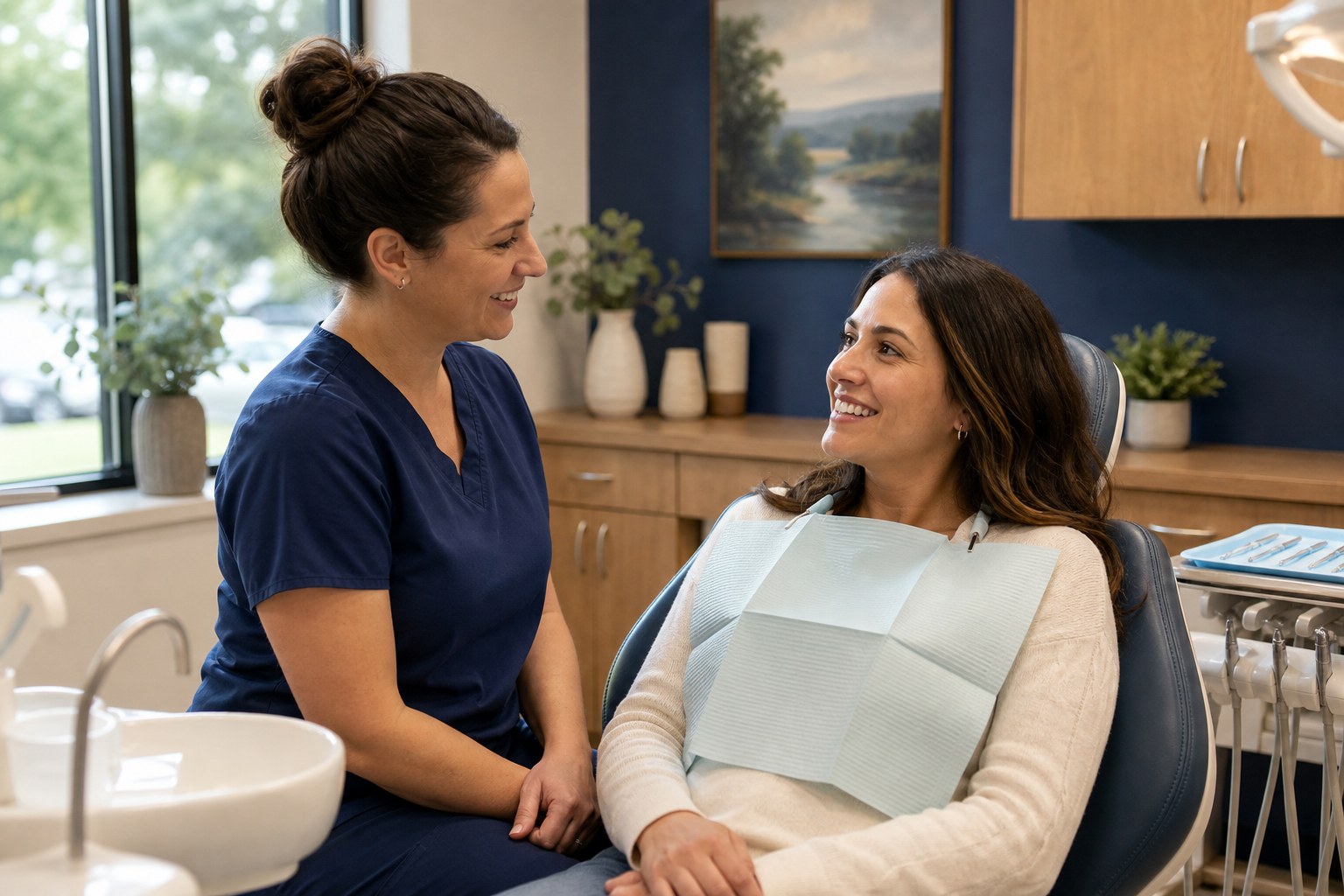
Told you need a deep cleaning? Dr. Brenda Gong explains scaling and root planing in Angier, NC — why it's recommended, what happens during each visit, how to heal comfortably in the first two weeks, and how to keep your gums healthy afterward.
Why Your Hygienist Recommended a Deep Cleaning
If you have ever left a checkup hearing the words "you need a deep cleaning," it can feel like you did something wrong. You didn't. A deep cleaning — clinically called scaling and root planing — is simply the next step up from a regular cleaning when bacteria and hardened tartar have worked their way beneath the gumline, where a toothbrush and floss can no longer reach.
At Accent Family Dentistry in Angier, Dr. Brenda Gong and the team see this often in patients from Angier, Fuquay-Varina, Holly Springs, and Willow Spring who have gone a few years between visits, or who have a family history of gum problems. It is one of the most common treatments in the practice, and one of the most effective at protecting the teeth you already have.
The difference comes down to depth. A routine cleaning polishes the crowns of your teeth and the shallow space just under the gum. A deep cleaning treats the pockets that form when gum tissue pulls away from the root — the space where gum disease quietly does its damage.
Signs Your Gums May Need More Than a Regular Cleaning
Gum disease rarely hurts in its early stages, which is exactly why it goes unnoticed. Dr. Gong looks for a combination of what she sees on the exam, what shows on the X-rays, and the pocket depths measured around each tooth. Anything consistently deeper than about four millimeters, paired with bleeding or bone loss, usually points toward scaling and root planing.
Symptoms patients commonly notice at home include:
• Bleeding when you brush or floss — healthy gums shouldn't bleed, even if you are thorough.
• Persistent bad breath that returns within an hour of brushing.
• Gums that look puffy, red, or shiny rather than firm and pink.
• Teeth that look longer as the gumline recedes.
• A tooth that feels slightly loose or shifts when you bite.
None of these mean you are headed for extractions. They mean it is time for a measurement appointment. Catching gum disease at this stage is the difference between a few treatment visits and a much longer road involving gum disease laser therapy or tooth replacement later on.
What Happens During Scaling and Root Planing
The visit is more comfortable than most people expect. Deep cleanings are usually split into two appointments — one side of the mouth at a time — so you are never numb across your whole face and each area gets unhurried attention.
• Numbing first. The area is fully anesthetized before anything begins. Patients routinely tell Dr. Gong afterward that they felt pressure and water, nothing sharp.
• Scaling. Ultrasonic and hand instruments remove tartar and bacterial buildup from the tooth surface and from inside the pocket below the gumline.
• Root planing. The root surface is smoothed so bacteria have less to cling to and the gum tissue can reattach snugly against the tooth.
• Targeted antibiotic when needed. For deeper pockets, Dr. Gong may place Arestin, an antibiotic powder that sits in the pocket and keeps working for days after you leave.
Each side typically takes about an hour. If dental anxiety has kept you away, say so when you book — the practice offers sedation options, and the team is used to going slowly, explaining as they work, and stopping whenever you raise a hand.
Healing at Home in the First Two Weeks
Most patients go back to work the same afternoon. Expect some tenderness and temporary cold sensitivity for a few days, because the root surfaces that were buried in tartar are now exposed to the open air for the first time in years.
• Eat soft and lukewarm for the first day or two — soup, eggs, pasta, smoothies without a straw.
• Rinse with warm salt water a few times a day to calm the tissue.
• Keep brushing gently, including along the gumline. Skipping it slows healing more than the soreness does.
• Use a sensitivity toothpaste for a couple of weeks if cold bothers you.
• Skip tobacco. Nicotine restricts blood flow to the gums and is the single biggest reason deep cleanings fail to hold.
About four to six weeks later you'll come back so Dr. Gong can re-measure those same pockets. Seeing a five-millimeter pocket come back at three is one of the most satisfying moments in the operatory — proof the tissue has reattached.
Staying Healthy After Treatment
Gum disease is managed, not cured, so what happens after treatment matters as much as the treatment itself. Instead of returning to a standard six-month schedule, most patients move to periodontal maintenance visits every three or four months. That shorter interval keeps bacteria from re-colonizing the pockets before your gums can be cleaned again.
Between visits, the basics do the heavy lifting: brushing twice a day for two full minutes, cleaning between the teeth daily with floss or a water flosser, and telling the team about any new bleeding rather than waiting for the next appointment. You can read more about the practice's approach on the periodontal care and dental cleanings pages.
Schedule a Gum Evaluation in Angier
Accent Family Dentistry is a family-owned, independent practice on E Depot Street in Angier, caring for families from Apex, Lillington, Coats, Benson, and the surrounding communities. Dr. Gong will tell you plainly what your gums need — and what they don't. If a regular cleaning is enough, that's what you'll get.
The practice has bilingual team members, and Spanish-speaking patients are always welcome. Call 919-639-3911 or stop by 86 E Depot St, Angier, NC 27501. Office hours are Monday through Thursday, 9:00 AM to 6:30 PM.
If it has been a while since your last visit, that's all the more reason to come in. Gums respond remarkably well to attention — usually much faster than people expect.
Ready to schedule an appointment?
Call Accent Family Dentistry in Angier, NC at 919-639-3911 or use our online scheduler.
Schedule OnlineQuestions About Your Dental Health?
Dr. Gong and her team are always happy to answer your questions and help you understand your treatment options.